
New Orleans Property Tax Records
New Orleans property tax records are kept by the Orleans Parish Assessor and collected through the consolidated city-parish government. Because New Orleans and Orleans Parish share the same boundaries, there is no separate city tax system. All property tax records for New Orleans go through the parish. You can search these records online at the assessor's website, check tax payment status, and look up assessed values. The Orleans Parish Assessor handles all assessment rolls, homestead exemptions, and property classification questions for every property inside New Orleans.
New Orleans Quick Facts
New Orleans Tax Records and Parish Structure
New Orleans is unique in Louisiana. The city and parish are one and the same. There is no separate city government collecting property taxes on top of the parish. Every tax bill in New Orleans comes from the consolidated system. This means you deal with one set of offices for all your property tax needs. The Orleans Parish Assessor sets the assessed value. The tax collector sends out the bills. It is a simple setup compared to places where a city sits inside a larger parish.
Under La. Const. Art. VII Section 18, residential property in New Orleans is assessed at 10% of fair market value. Commercial property gets assessed at 15%. Land is also at 10%. These rates apply across every parish in the state. But the millage rates that multiply against those assessed values differ from one taxing district to the next. New Orleans has school board taxes, levee board taxes, and other special district assessments layered on top of the base parish millage.
The homestead exemption is a big deal in New Orleans. Most cities in Louisiana do not let the homestead exemption apply to city taxes. Orleans Parish is the exception. Under La. R.S. 47:1703, the $7,500 assessed value exemption (equal to $75,000 of market value) applies to city taxes here. Certain police and fire protection millages are still excluded from the exemption, but the bulk of your tax bill gets that break if you own and live in your home.
Orleans Parish Assessor and New Orleans Records
The Orleans Parish Assessor's office handles all property assessments in New Orleans. They keep records on every parcel in the city. You can look up any property by address or parcel number on their site. The office also processes homestead exemption applications and handles classification questions.
| Office | Orleans Parish Assessor |
|---|---|
| Website | nolaassessor.com |
| Tax Payments | Online Payment Portal |
| City Portal | nola.gov/property-tax |
The assessor's office in New Orleans sets values based on fair market value as defined by La. R.S. 47:2321. That statute says fair market value is the price a willing buyer and a willing seller would agree to under normal conditions. If you think your value is too high, you have the right to appeal. Start at the assessor's office, then go to the Board of Review if needed.
The main Orleans Parish Assessor website shows the assessed value for New Orleans properties, along with the tax district information.

From this portal you can pull up detailed records for any New Orleans property. The site shows land value, improvement value, total assessed value, and the exemptions on file. It is the fastest way to check your New Orleans property tax records without calling anyone.
Paying New Orleans Property Taxes
Tax bills go out once a year. You can pay online through the Orleans Parish tax payment system. The site lets you search by name or address. You can see what you owe and pay right there. The city also accepts payments by mail and in person.
The tax payment portal for Orleans Parish shows the current balance, past due amounts, and payment history for New Orleans properties.
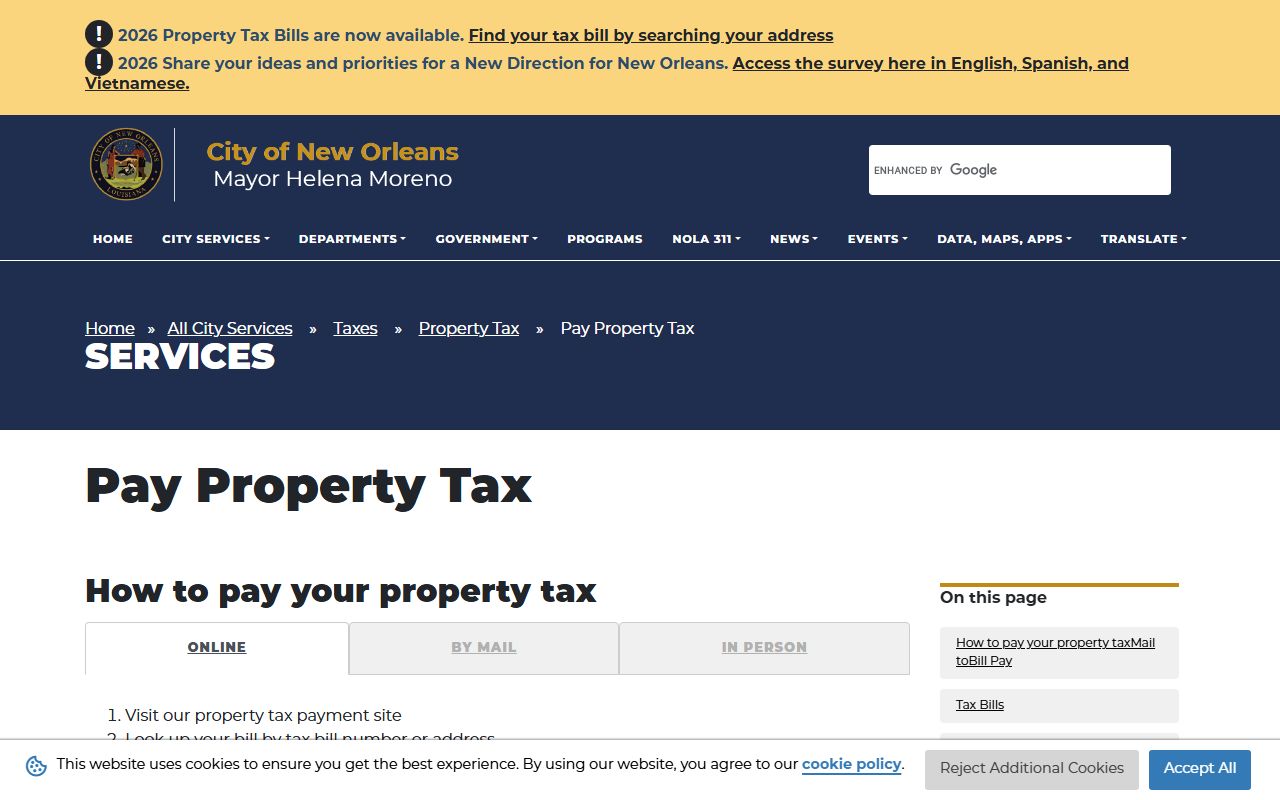
If you miss a deadline, penalties start to add up. Louisiana law allows the tax collector to sell properties that stay delinquent. Tax sales in New Orleans happen annually. Properties that go through a tax sale become adjudicated to the parish. The City of New Orleans property tax page has deadline information and links to pay.
Note: Property owners in New Orleans should check for special assessment district charges that may appear as separate line items on their tax bills.
Property Tax Appeals in New Orleans
Every property owner in New Orleans can challenge their assessed value. The appeal process follows state law under La. R.S. 47:1992. You start by talking to the assessor's office. If that does not resolve it, you file with the Orleans Parish Board of Review during the 15-day open period after assessment rolls go public.
The Board of Review hears your case and makes a ruling. If you still disagree, you have 10 business days to appeal to the Louisiana Tax Commission. The Commission holds hearings and issues a final administrative decision. After that, judicial review is available within 30 days. Most New Orleans property tax disputes get settled at the Board of Review level. Few go all the way to the Tax Commission.
Under La. R.S. 47:2331, all real property in New Orleans gets reassessed at least every four years. This is the quadrennial reassessment cycle. The Louisiana Tax Commission sets the schedule. When a reassessment year hits, many New Orleans property owners see changes in their assessed values. That is the most common time to file an appeal.
New Orleans Homestead Exemption Details
The homestead exemption cuts the taxable assessed value of your home by $7,500. That means the first $75,000 of your home's market value is exempt from most property taxes. You must own and live in the home to qualify. File the application at the Orleans Parish Assessor's office. You need your deed, a valid ID, and proof that you live there.
New Orleans is one of the few places in Louisiana where the homestead exemption applies to city-level taxes. In most other cities, the exemption only covers parish and school taxes. Since New Orleans and Orleans Parish are consolidated, the exemption covers the full tax bill except for certain police and fire protection millages. Seniors age 65 and older may also qualify for a special assessment level freeze under La. R.S. 47:1703. This keeps the assessed value from going up as long as the owner's income stays below the threshold set each year.
New Orleans Property Tax Districts
New Orleans has a complex tax structure. Multiple taxing bodies levy millage against your property. The school board, levee board, and various special districts all add to the total bill. Each district has its own millage rate. When you look at a New Orleans property tax record, you will see each line item broken out separately.
Some of these special districts fund drainage, sewerage, parks, or specific neighborhood improvements. The total millage in New Orleans can be higher than in surrounding areas because of all these layered districts. But the homestead exemption helps offset that for owner-occupied homes. You can see the full breakdown of millages on your tax bill or through the assessor's website. Under La. R.S. 47:1951, all property in Louisiana is subject to tax on January 1 of each year unless specifically exempted by the constitution.
Note: The total millage rate in New Orleans varies by tax district, so two properties in different parts of the city may have different total rates even if their assessed values are the same.
Historical Tax Records for New Orleans
The Louisiana State Land Office keeps historical property tax adjudication records for New Orleans from 1880 to 1973. These are free to download in TIF format. You can search by parish, tax year, ward, or document number. For records after 1973, you need to go through the Orleans Parish offices directly.
These old records can be useful for title searches, genealogy research, or tracing property ownership through the decades. The State Land Office database is simple to use. Pick Orleans Parish from the list, select a tax year range, and browse the results. Each document shows the property description, the owner at the time, and whether the property was adjudicated for unpaid taxes.
Orleans Parish Property Tax Records
New Orleans sits entirely within Orleans Parish. All property tax records, assessment rolls, and tax payment data flow through the parish system. For full details on the Orleans Parish Assessor, fee schedules, appeal deadlines, and links to every parish-level resource, visit the Orleans Parish property tax records page.